Showing posts with label travis. Show all posts

2/27/2020

Review: 'Burden', Garrett Hedlund Seeks Redemption In Unfocused But Well-Meaning Race Drama


*NOTE: This is a reprint of my review from the 2018 Sundance Film Festival. Burden opens in theaters tomorrow, February 28th. *

Nowadays the KKK aren't dressed in hoods burning torches on front lawns; they're in boardrooms and college universities carrying tiki torches. So Andrew Heckler's comically overwrought drama Burden, which is set in 1996, feels old fashioned right from jump street. And given the real-world events, it depicts some may be willing to forgive that, certainly these kinds of message heavy movies about southern racism were more prevalent some years ago. But in execution, it still needs to do something new to make this particular story feel unique, and despite a couple of winning performances that fails to happen.

One of those performances does not belong to Garrett Hedlund, who as KKK member Mike Burden mumbles and sways through each scene like a drunk with a mouthful of old paper towels.  The ironically-named Mike Burden (His name immediately recalls the film White Man's Burden) is part of a small Klan group in Laurens, South Carolina that bought an old movie theater and opened The Redneck KKK Museum. Yeah, that's what it was actually called. Led by his father figure Tom Griffin (Tom Wilkinson, a terrific heel), Mike is a loyal foot soldier. The film begins by showing Mike and the little family of Klansmen he runs with, not as racists stoking societal fires, but as everyday folks who do normal things. Then they pull the rug out; Oh...these guys are a bunch of bigots. Got it. Guess that's one cookout I won't be attending.

The shorthand for this movie could read as such: "KKK member finds a better way thanks to the love of a good white woman."  That's the wrong perspective for this movie to have. Nevertheless, Andrea Riseborough, who has four movies at Sundance this year, gives the film's strongest performance as Judy, a single mother who rejects the racism she sees around town. But she has an interest in Mike, and they fall in love despite his beliefs going against hers in such an extreme way. Much of the film is spent navigating their relationship, and most of it is utterly ridiculous. Too often she'll reject Mike for something horrible he's done or said, like using the N-word, laugh at obviously racist jokes, or beat up a black man, while holding him in her arms and allowing him to stay in her home and influence her child. It never makes sense, and her protestations, at least for me, fell on deaf ears.

More compelling than Mike's eventual evolution is that of Reverend Kennedy (Forest Whitaker), who finds his faith tested while rioting against the museum. As a man of God who repeatedly preaches the value of forgiveness towards one's enemies, he's forced to put words to action when Mike, who eventually runs afoul of Tom and leaves the KKK, is in desperate need of help. At that point the Reverend must do more than put his faith in God, he must put it in men to do what's right. It's a choice that doesn't necessarily sit well with his family or other members of the community.

Heckler would have been wiser to center this story around the Reverend, rather than Mike who is so distasteful that we don't care much about his transformation. Hedlund's unconvincing performance doesn't help, either, which is unfortunate because Whitaker and Riseborough really do some fine, sensitive work here. But the script doesn't allow for much beyond what the actors are able to bring on their own. Unable to really differentiate his film from others, Heckler artificially raises the stakes so often that we become numb to it. If tensions are boiling, something terrible will definitely happen. We're meant to be "shocked" by the brazenness of the racists with such regularity (In one scene they urinate on a random girl just walking home) that they become hard to take seriously.

Heckler means well, and he makes a valiant effort to show that love can overcome hate if given room to grow. He's also keenly aware of how much economic hardship factors into bigotry, as poor white men feel compelled to exercise power over the one group worse off than them. Or worse, they act violently out of jealousy towards blacks who have succeeded where they haven't. But Heckler makes these points without much style or grace, something the story told in Burden desperately needs.

Rating: 2.5 out of 5

Review: 'Guns Akimbo' Misfires Despite Daniel Radcliffe And Samara Weaving Earning Top Scores


If you found the energetic video game energy of Hardcore Henry palatable, there's a chance Jason Lei Howden's similarly riffed Guns Akimbo will be up your alley. But unlike that previous FPS-level actioner, there's little to engage viewers beyond the sheer wildness of its premise and enjoyable stars Daniel Radcliffe and Samara Weaving as they slum it in a movie that wishes it were half as zany as Crank.

Considering the recent controversy surrounding Howden's social media attacks on two female writers of color, it's interesting that his Guns Akimbo hero is Miles, a bullied techie who gets his kicks being an a-hole to others from the safety of his dorky apartment. Still coping with his recent breakup from Nova (Natasha Liu Bordizzo), Miles' only real enjoyment now is stoking the online trolls who watch Skizm, a global phenomenon in which real death matches are fought and broadcast live from the streets of Shrapnel City. Imagine if The Running Man had been given a nasty upgrade, and you get the idea. Even the folks who run it look like refugees from an apocalyptic future, and when their leader Riktor (Ned Dennehy), gets sick of Miles' attitude, he decides to make him part of the game.


For the surprisingly dim-witted Miles, this means having a pair of revolvers bolted into his hands. If you thought Edward Scissorhands had it rough, Miles Pistolhands has it at least half as bad. Informed he'll also need to survive the onslaught of Skizm's master assassin, the killer valkyrie Nix (Weaving), Miles is mostly concerned that he doesn't know how to pee with a pair of cannons for hands. It's funny to watch Radcliffe, in yet another macabre role, fumble around to use his phone, or to eat, but the joke is thin and wears off quickly.

Fortunately, Weaving is pretty kickass as Nix, the drug-addicted, eyebrow-free reject who slaughters her foes in such easy, over-the-top fashion it's like something out of Mortal Kombat, or the Clive Owen flick Shoot 'em Up. She's so good, literally offing dozens with her eyes closed, it's completely unbelievable that the hapless Miles eludes her for most of the movie. Suspension of belief is necessary for a movie like Guns Akimbo, but this is just a bridge too far. The guy can't even eat a hot dog (a really gross, disgusting street dog acquired from a homeless guy) normally and yet he manages to stay alive without any real explanation as to how or why. It's hard not to get a kick at the hopelessly outmatched Miles, though, with his two little pistols and their 50-rounds of ammo; while every time Nix shows up she's had a serious weapons upgrade, ultimately coming armed with bazookas to use against the pathetic gamer.


Howden, who also wrote the script, puts the bulk of his energy in the insane visuals. His camerawork, a variety of twisting, turning aerials and angles, are  occasionally "cool" but aren't backed up by a consistent look, and certainly not by an engaging story. We are never given any reason to give a damn about Miles, and you might come away hoping he's just another stain on the sidewalk. Howden's technical skills are slick and promising, but like a video game with great graphics and poor controls, Guns Akimbo just falls short of being worth the time.

2.5 out of 5
2/26/2020

Review: 'The Invisible Man', Elisabeth Moss Takes On An Unseen Predator In Universal's Taut, Timely Horror Remake


If only Universal's failed Dark Universe plan had begun with Leigh Whannell's terrifically nervy and audacious The Invisible Man. A loose reimagining of H.G. Wells' classic book, the film could've given the studio's dud of a cinematic universe the spark it needed to thrive, driven by pinpoint direction and a modern spin that evokes "Me Too", privacy concerns, and gaslighting.  Whannell's third solo directing gig after Insidious 3 and the wildly underrated Upgrade (a superior version of Venom), this edgy psychological horror frays the senses as intensely as anything experienced in A Quiet Place.

That tension begins to churn at our gut during a killer slow burn of an escape sequence, as Cecilia Kass (Elisabeth Moss, unhinged and lovin' it) slowly creeps out of the gigantic, isolated home of her abusive boyfriend, Adrian Griffin (Oliver Jackson-Cohen), a tech mogul with a very specific specialty. The next few minutes are a masterclass in the use of sound and darkness to create fear, every step Cecilia takes is nearly silent, but made to feel heavy as a drumbeat. By the time she scales the walls and races out into a lonely, dark street to await the arrival of her confused sister Alice (Harriet Dyer), our skin is crawling.


What emerges is that Cecilia has been living under the violent specter of Adrian for so long, and yet nobody seems to have realized it. Alice had no idea, and the same goes for her cop friend James (Aldis Hodge) or his college-bound daughter Sydney (Storm Reid). Adrian has controlled every aspect of her life, which explains why the promising architect has done nothing with her career, and why she's afraid to leave James' home even to check the mailbox. Even when Cecilia, or "C" as her friends annoyingly call her, begins to think herself safe following news Adrian has killed himself, she doesn't seem to fully trust it.

Of course, Cecilia's instincts prove to be spot-on, and before long she's the victim of unseen attacks. Actually, that's overstating it. She becomes the victim of an annoying, manipulative pest who starts out by silently moving things around the kitchen, causing her to burn breakfast, then quickly builds up to isolating Cecilia from her friends and family. The way this is done is so surgical, so cruel, we can see the patterns in the way real-life abusive men drive their victims away from the people they rely on for support. The more Cecilia screams that Adrian is alive, the more broken from reality everyone thinks her to be, because who could possibly believe such a story? What is he? A ghost? Somehow he faked his death? The gaslighting going on here is truly epic stuff, and far more terrifying than the invisible stalker's footprints or their hot breath emerging out of nowhere on a cold night. Whannell, who has been freaking folks out since he and James Wan launched the Saw franchise, knows there are limits and keeps Cecilia's confrontations with her unseen foe to a minimum. He flips the tables (literally, at one point) at just the right moment so things don't get repetitive, and we stay on board with Cecilia's attempts to prove she isn't crazy.


One of the few drawbacks is so much of the movie's second half was given away in trailers. Not all of it, mind you, there are a few red herrings and bloody plot twists (one death scene is a real jaw-dropper) that throw a monkeywrench into our expectations. But nearly everything directly involving Cecilia is out there, and that's a shame. Eventually, The Invisible Man lives up to its title and the big question becomes "how" as much as "who", and the reveal is pretty weak even if it makes some logical sense. When you're talking about classic movie monsters, satisfying is probably a better way to go than logical, and this just comes across as an easy answer to a pesky plot point that might've been left unanswered.

We can probably leave it unsaid that Moss is great, once again, at playing a woman on the edge. Her performance carries Cecilia through maddeningly unstable to in a desperate fight, not just for survival but to prove her own sanity. While definitely a "showy" role, what Moss delivers actually mirrors Whannell's approach to the film, which is to keep its themes and Cecilia's backstory of abuse as understated as possible. Trusting the audience to engage with these aspects is one of the most visible reasons why The Invisible Man is a big win for Universal and Blumhouse as they redefine what it means to be "monster" in today's world.

3.5 out of 5


2/24/2020

Review: 'Onward', Pixar's Elven Adventure Has Heart But Lacks The Usual Magic


Such is the price of Pixar's incredible success that we basically grade their movies one of two ways: either they're instant classics, or they're simply enjoyable. You won't find any that are outright bad, although the potential for disappointment is always there due to unfairly high expectations. Simply put, other studios wish they could measure up to Pixar's scraps, and if Onward were from anybody else we'd be praising it as being Pixar-worthy. Oddly enough, being from Pixar is exactly why this curious roadtrip oddity feels like just another day at the animation office.


A mix of Harry Potter, Warcraft, and Weekend at Bernie's, Pixar has something truly weird on their hands. Despite all of the magical journeys Pixar has taken us on over the years, Onward is actually set in a fantasy world, one of true magic, and yet it only sporadically has the sense of wonder we're accustomed to. While still deeply intimate, packing quite an emotional punch in the bookending sequences like ALL Pixar movies do, it's the story itself that travels fairly generic territory.


Marvel bros Tom Holland and Chris Pratt voice elf brothers Ian and Barley Lightfoot, who live in a common suburb in a world very much like our own. But in a brilliant introduction we see that this used to be a place of great magic, where wizards who could wield it were worshipped. But then somebody screwed it up by introducing technology, and suddenly everyone started looking for the easy way out. So the ease of technological advancement has sapped the world of its magic and imagination; the mighty centaurs no longer run wild but are overweight cops, like the boyfriend to Ian and Barley's single mother Laurel (Julia Louis-Dreyfus); the once-proud unicorn is basically like a garbage-devouring raccoon, and dragons are domesticated as dogs. And who needs a magic spell to get anywhere when you can climb into an airplane, a car, or a beat up old van named Guinevere?


But maybe there's still a little magic left out there in the world? That's what Ian's dead father hoped, and he arranged for his future son to receive quite the gift on his 16th birthday. It turns out to be a magic staff, one capable of incredible powers, including a spell to return dear ol' dad back to the land of the living for 24 hours, so he can see who his sons grew up to be. But Ian, lacking any confidence and still being new at this whole magic thing, botches the spell and only returns half of his dad, a pair of disembodied legs, which is pretty morbid especially for a Pixar movie.


I was actually down for it being morbid and twisted, if Pixar were willing to really run with it. Occasionally, they do, but those moments are fleeting. Ian and Barley set out on a journey to find a rare "Phoenix stone" to complete the rest of the spell, dragging daddy long legs with them in a variety of ridiculous disguises. But other than an unusually-timed dance sequence, the bulk of the humor comes from the mismatched siblings. Ian is one of the least-compelling leads Pixar has given us this side of The Good Dinosaur. His entire thing is that he's shy, introverted, nervous, and desperately wants to be the confident guy others say his father was. Barley is far more interesting, though. A mix of every frat boy character Chris Pratt has ever played, from Parks & Rec to 10 Years to Guardians of the Galaxy, Barley is an expert in magical spells because he's a fierce Dungeons & Dragons player, insisting the game is historically accurate in every way. For all of Barley's knowledge, he doesn't have the magic gift, only his disbelieving brother Ian does. Being the older  bro, Barley has the stigma of being a slacker and a loser. If this were the 1980s and this weren't a Disney/Pixar movie, he'd be carrying around a bong. But magic is something Barley knows, and part of this adventure is proving to Ian that he's someone who can be counted on.


All of this plays out with sincerity and earnestness, making for a film that will pluck at your heartstrings when it needs to, and have you chuckling at the mundane repercussions for some of the world's most magical creatures. Octavia Spencer plays a once-fearsome manticore who has been reduced to running a Chuck E. Cheese-like restaurant, worried about investors and potential lawsuits. She teams up with Laurel to have an epic quest of their own, which is fun enough to maybe launch one of Pixar's terrific shorts in the future. But some of the other diversions like creative punch, like an encounter with a gang of angry motorcycle pixies. The ensuing car chase is pretty forgettable. The whole time it's tough to shake that Onward is set in the most fantastical of settings and the bulk of it finds Ian and Barley unsure which direction they should drive in their van. Surely, there's something more they could've done? That goes to the movie's visuals, as well. Sitting down to it, my first thought was this looked like a Dreamworks or Sony Animation film. They're perfectly fine, just not up to Pixar's vibrant standards. But that's pretty much par for the course for Onward, a film that sits smack dab in the middle of the Pixar totem pole.

3 out of 5

2/20/2020

Review: 'The Night Clerk', Tye Sheridan & Ana De Armas Check-In For A Dull Murder Mystery


People watching. We all do it. Some couples make dates out of it. We like it when we can watch people and see what they're doing, as long as they don't know we're doing it. It's a concept that Hollywood has long been enamored with, whether it be Alfred Hitchcock's classic Rear Window, or a more recent thriller like The Girl on the Train. In Michael Cristofer's The Night Clerk is the latest to use voyeurism as a throughway into a fairly conventional murder mystery, only this time it's seen through the eyes of a character afflicted with Asperger syndrome.

This is nothing against the movie's star, Tye Sheridan, who is generally pretty good as Bart Bromley, the socially-awkward night clerk at a hotel chain, but the way Hollywood presents characters with developmental disorders is getting worse, not better. Bart is, predictably, a misfit loner who mumbles in social situations, rattles off long-winded explanations for things nobody cares about, and obsesses over the tiniest of details. He's so uncomfortable being around people, that he uses stealth cameras to spy on people in the hotel. He even spies on his own mother (Helen Hunt) from the basement of their home, so he knows when to come up and get the dinner she leaves on the steps.  He's like a spaceman from another planet, not an actual human. His Asperger's is a cheap way for the audience to question his grip on reality, but at least the movie stops short of just saying he's crazy.


Moving at a pace equivalent to a three-toed sloth, The Night Clerk finds Bart in hot water when his cameras pick-up a hotel guest being murdered by her male lover. Bart's arrival on the scene, during his off hours, is suspicious, and detective Johnny Espada (John Leguizamo) immediately sniffs out that something is wrong with the oddball night clerk.  He does that thing Hollywood thinks all a-holes do to shy, introverted guys like Bart, and starts asking him a bunch of really pointed questions about sex. Bart gets nervous, which makes him look like a suspect, and Espada won't let it go.

Shuffled off to another hotel to avoid embarrassment, Bart meets the beautiful, mysterious Andrea (Knives Out's Ana de Armas). She recognizes in Bart the same loneliness she grapples with every day, and the two become, if not friends, at least a comfort from a harsh world. The question that Bart may not have the faculties to ask is why the world would be as cruel to someone like her as it is to him? What secrets is she hiding?


That question is put on the backburner, as so much of the movie's murder plot is for the duration of The Night Clerk's 90-minute runtime. Overall, the focus on the connection between Bart and Andrea is the right move for Cristofer to take, but in execution it just goes nowhere and does it very slowly. In his first directing gig in nearly two decades, his last being the 2001 Angelina Jolie dud Original Sin, Cristofer delivers a pretty, polished drama with an unfocused, meandering plot. He seems to have no idea how the murder investigation should develop, which relegates Leguizamo to the sidelines until he's needed again much later. Cristofer's script uses Bart's condition for a few moments of ill-advised humor. In a weird stretch that was clearly designed to punch up the movie's ponderous tone, Bart goes on a run of insulting people he just met, like telling the car salesman that he's fat, or the clothier that he would never buy clothes from someone so old. He can't prevent himself from telling people things they don't want to hear. It's just such an odd thing to include because it has no bearing on the plot, and doesn't seem to be a problem for him at any other time in the movie.

The Night Clerk may have worked out better if there were no murder mystery to contend with, because the relationship between Bart and Andrea has some interesting layers to it. She's a difficult character to pin down, almost a classic femme fatale in that sense. De Armas has this disarming way about her, making it difficult to tell if Andrea is looking out for herself, or if her feelings towards Bart are true. While Bart is too inexperienced to recognize just how complicated Andrea really is, he's drawn to the fact she doesn't judge him, and treats him like a normal person. He still has the stock answers he drops robotically into conversations, but with her some of that goes away. There's surprising chemistry between Sheridan and de Armas, which could've been explored fully if the needs of a dull thriller subplot didn't interfere.

2.5 out of 5
Review: 'Buffaloed', Zoey Deutch Comes To Collect In Charming Blue-Collar Comedy


Is there anybody who doesn't love Zoey Deutch? The effervescent comedienne lights up just about every movie she's in, and even has us rooting for her as a shady debt collector in Buffaloed. The blue collar comedy from director Tanya Wexler (Hysteria) has Deutch delivering the info and the funny, not unlike The Big Short or The Other Guys, about an entire industry built on corrupt debt-collecting practices that snows its victims worse than a Buffalo blizzard.

Deutch plays the whip-smart and scrappy Peg Dahl, a South Buffalo gal who has always fought to break out from her chilly upstate confines. More than anything she doesn't want to struggle to make ends meet, the way she sees her hairdresser mom (Judy Greer) do every single day. The brainy Peg thinks she's found a way out when an Ivy League school grants her admission, only to realize she has no way to pay for it. So Peg does what she does best, which is put her homegrown business sense to good use as a debt collector.


This epiphany doesn't happen on its own. It comes after a raft of sketchy ideas, including the counterfeiting of Buffalo Bills tickets (which earns the ire of the team's hardcore faithful), which land her in prison on a four-year stretch. Peg always has an angle, finding new ways to make money is what she's good at, and debt is literally all about money. Cha-ching.

Jai Courtney co-stars as Peg's scumbag boss, Wizz, who runs his debt collecting biz like a scene out of Boiler Room, or a low rent Glengarry Glenn Ross...which I guess is sorta what Boiler Room was.  His criminal practices make big bucks screwing people over, and Peg breaks the fourth wall (again, much like The Big Short) to breakdown the many ways debt collectors get away with murder. In execution it comes across as clunky and heavy-handed, but the charming Deutch makes for an entertaining teacher.


There's quite a bit going on in Buffaloed and screenwriter Brian Sacca struggles to keep all of his balls in the air. As Peg branches off into her own debt collecting practice, gathering a group of like-minded misfits, she pisses off her all-male rivals of junior mafiosos. There's also Peg's messy on again/off again relationship with an altruistic District Attorney (Jermaine Fowler) looking to clean up the industry. Peg is an interesting character, because we want to cheer her on even though she's doing some pretty terrible things. It's just that guys like Wizz are just slightly worse. The schemes both use are deceptive, bordering on illegal (or outright illegal), the only real difference is who gets screwed in the end. Does that make Peg much better?

It takes all of Deutch's charm, which is a considerable amount, to get us in Peg's corner. Just as the titular city has embraced the underdog status of its beloved Buffalo Bills, Buffaloed fights really hard for our attentions when it could be so easily overlooked. Thanks to Deutch and a lively, informative script, the gamble mostly pays off.

3 out of 5

2/19/2020

Review: 'Ordinary Love', Lesley Manville And Liam Neeson Are Uncommonly Good In Lively, Observant Cancer Drama


Ordinary Love is bookended by long-married couple Tom (Liam Neeson) and Joan (Lesley Manville) walking for exercise in their Northern Ireland suburb. It's such a normal thing, you can tell they've made it part of their routine, something they do together as they've done all things together for so long. It's a sign of their deep affection and reliance on one another, and by the time we see them do it again, those walks will have come to mean so much more after a year of turmoil brought on by a cancer diagnosis.

First time screenwriter Owen McCafferty's Ordinary Love is a beautiful, funny, and deeply intimate drama about two people faced with an uncertain future, one they never imagined could be without the other. For Tom and Joan, the gentle ribbing they give one another is the way they communicate; it's become a part of who they are and how they show that everything is alright, even when it's not. When Joan asks Tom to come and feel her breast, he responds with a characteristic sex joke. Only she's not kidding around this time.  This is serious, something is wrong.


The broad strokes of Joan's breast cancer diagnosis are largely skipped over by Good Vibrations directors Lisa Barros D'Sa and husband Glenn Leyburn, and it's for the better. We've seen all of that stuff before, anyway: the chemotherapy, the vomiting, the hair loss. The small details are what matter here; like the terrifying sound the machines make during a biopsy, the flash of anxiety that crosses Tom and Joan's face the moment before a doctor's update, the subtle smile that crosses their faces at the end of one of their many phony arguments, and the way Tom always offers tea as a means of smoothing things over.

These are the things that matter, and Ordinary Love obsesses over them, perhaps too much for some audiences. It can begin to feel like nothing is really happening because the pace is so slow, but this also gives wide berth for Neeson and Manville to fill those quiet spaces with the emotional complexity that comes with facing extraordinary adversity. Tom's sense of humor is often what puts Joan at ease, it's also a rare  source of conflict as he tries to keep life normal and she deals with the reality. This is one time they'll need to take separate paths to get through the other side.  It should go without saying the performances are pitch-perfect and the chemistry between Neeson and Manville impeccable. When not beating people up, Neeson still strikes a stoic, imposing figure, and it hurts to see him when Tom finally breaks down in anguish. But this is Manville's movie. She remains watchable as ever, an actress you never want to turn away from even as the camera holds on her face in a moment of silent distress.


The dull blues and grays of hospitals brings a morose pallor, but is eventually forgiven with jokes about giving the bedroom a fresh splash of color. The movie's real beauty, anyway, is the way Tom and Joan look at one another throughout. There are fears and anxieties which occasionally burst forth in anger, but the eyes show nothing but commitment, resiliency, and love. An ambient scored by David Holmes and Brian Irvine never holds our hand through the joys and pains, nor does McCafferty's script fill in all of the blanks. We never learn the details of the death of Tom and Joan's daughter, Debbie, some time in the past. All we need to know is that they, unlike so many couples in similarly tragic dramas, got through it stronger than ever. As prelude, it makes for a valuable lesson that life still waits for us on the other side of tragedy, and that life, even at its most mundane, can still be extraordinary.

4 out of 5

2/18/2020

Review: Disney's 'The Call Of The Wild', Harrison Ford Heeds The Call But Digital Effects Are Tame


It wasn't long ago that Harrison Ford starred in his first animated voice role, that of a protective dog in The Secret Life of Pets 2. Ford isn't the guy we typically associate with family-friendly movies like that, and yet Disney's The Call of the Wild finds him paired up with a CGI canine who is undoubtedly the star of the show. To Ford's credit, he gives the chief human role all that he can considering that he's playing second-fiddle to an animated pet. But for a movie that's all about learning to embrace one's natural instincts, the decision to rely so much on computer technology was a misstep.

The Call of the Wild is based on the classic Jack London novel from the early 20th-century, which has been adapted multiple times. For very good reason, it's a classic tale of survival told through the eyes of Buck, a domesticated, very spoiled St. Bernard who is dognapped from his comfortable existence and shipped out to the Yukon during the Gold Rush. There, he experiences the wilds of nature, faces dangers he's never seen, and encounters the good and bad side of men, eventually learning to embrace the wild animal within. It's a dark story, which made the decision by Disney to bring it over from 20th Century Fox somewhat unusual.


The answer?  Exaggerate Buck and all of the animals in such a way that they might as well be cartoons. Essentially a comedy for 80% of the time, The Call of the Wild finds Buck crashing his way through his home like a bull in a china shop, upsetting the locals and his family. It's this drawing of attention to himself that gets Buck stolen away to begin with, packed in a crate and shipped off to Alaska where powerful dogs are at a premium. It's there that Buck literally bumps into John Thornton (Ford), a lonely man looking to escape from a troubled past.  They instantly form a connection, but Buck's journey is one full of hardship, mostly at the hands of evil men.

Buck's initial trip is met with violence, as his handlers beat and threaten him into submission. It's there that Buck learns to be wary of people, something he never had to deal with in his comfortable early life. He's eventually sold into an Alaskan sled team run by the kind-hearted postman Perrault (a welcome Omar Sy) and the wary Francois (Cara Gee). They teach Buck to be part of a team, to be one with a pack, although it's also here that he learns to be fearful of his own kind, as well. Ultimately, Buck ends up in John's possession, who comes to his rescue from the greedy, malicious fop Hal (Dan Stevens). He believes John is hiding the location of a secret goldmine, and will stop at nothing to find it.


While I understand using real animals and locations makes for a more difficult, more expensive shoot, the entire thing being done in CGI is a serious problem. It's hard to take anything seriously with Buck's overemphasized facial expressions and mannerisms, while the wilderness, this uninhibited place where Buck is meant to lose himself to the "call of the wild", is too glossy and way too tame. Chris Sanders is a filmmaker best known for his animated work on How to Train Your Dragon and The Croods, but his expertise doesn't fit with this savage tale of survival and evolution, which has its edgiest aspects sanded down.

On the other hand, Ford is really doing some unexpectedly strong work here when he easily could've phoned it in. He imbues John Thornton with an emotional heaviness that you can tell he's been carrying for far too long. Through connecting with Buck, we see him drop some of the armor and learn to open up again. I would almost say the relationship is similar to Han Solo and Chewbacca, but it isn't quite on that level! Ford and motion-capture legend Terry Notary work side-by-side here and they have us believing in John and Buck's heartwarming friendship. At least The Call of the Wild makes that part of the story feel natural. It's just too bad so much else doesn't.

2.5 out of 5


2/13/2020

Review: 'The Photograph', A Beautiful Snapshot Of Modern Black Love


While there has been a clear rise in studio romances featuring black stars, it speaks to the relative lack of them that we still reach back to 1997's Love Jones as the prime example of black love represented on the big screen. The comparisons came quickly for The Photograph, a soulful, sultry film featuring the gorgeous, dark-skinned duo of Issa Rae and Lakeith Stanfield. As directed by Stella Meghie (Everything Everything), the film never shies away from the hues of her stars, instead she makes them glow in a mature love story that could've done with turning up the heat a little more.

If you're wondering why such a big deal is being made about the movie's brown-skinned stars, it's because too often black romances have skewed towards the lighter side. That's not a knock against the people in those movies, but Hollywood would rather give you Common and Paula Patton if they can keep getting away with it. So it's definitely a refreshing change to see a cast that leans towards the darker side, and to give us a chance to see Stanfield and Rae in a way we've never had the chance to before.

The Photograph centers on the unlikely romance between Mae (Rae) and Michael (Stanfield), two busy New York professionals having their struggles with commitment. For Michael, a photographer frequently traveling between the city and Louisiana for work, he's just coming out of a long-term, long-distance relationship. For Mae, staying committed is as unfathomable to her as it was to her estranged, recently-deceased mother, Christina (Chante Adams), a Louisiana photographer who fled the bayou for larger aspirations in the big city. Christina left behind at least one broken heart, Isaac (Rob Morgan), which is where Michael first sees her picture, and gets in touch with Mae to learn more about this elusive photog.

The story drifts somewhat clumsily between the 1980s, where Christina and a young Isaac (played by Rae's Insecure co-star Y'lan Noel) grapple with their conflicting ambitions; and the present where Mae and Michael face similar problems. Mae worries that she is just like her mother, incapable of standing still, too committed to her work. But when she's with Michael, those thoughts seem to melt away. Their first actual date actually looks and sounds like an actual date, where people talk about the things that connect us, in this case Drake vs. Kendrick Lamar. The conversation is natural, funny, and revealing. When Michael asks if it's too early for a kiss, we already know that it isn't.

Passion radiates from Rae and Stanfield together, including a steamy encounter during a raging hurricane ("Blame it on the storm", he says.). But for those expecting a bit more sizzle, The Photograph keeps it to a minimum. The woman sitting next to me literally asked on multiple occasions "That's it?", expecting to see a lot more action between the sheets. I couldn't help but agree. Instead, this is as much a movie about Mae's reconciling with her mother, attempting to figure out if they're both so broken as to be incapable of love. To illustrate the differences between the two women, Meghie spends an inordinate amount of time in Christina's past in Louisiana, with the flashbacks given a surreal, Nicholas Sparks-esque quality. Unfortunately, those scenes are as emotionally thin as one of Sparks' many adaptations, and are so somber it has us yearning for someone to spice things up. Lil Rel Howery and Teyonah Parris add a much-needed dose of humor as Michael's married brother and sister-in-law, who try and fail to warn him against falling too quickly in love

The Photograph is a stunningly beautiful movie, with Rae and Stanfield always kept in tight, warm focus by Meghie and DP Mark Schwartzbard. While the central romance is just a snapshot of what it could've been, modern black love has rarely looked so good.

3 out of 5


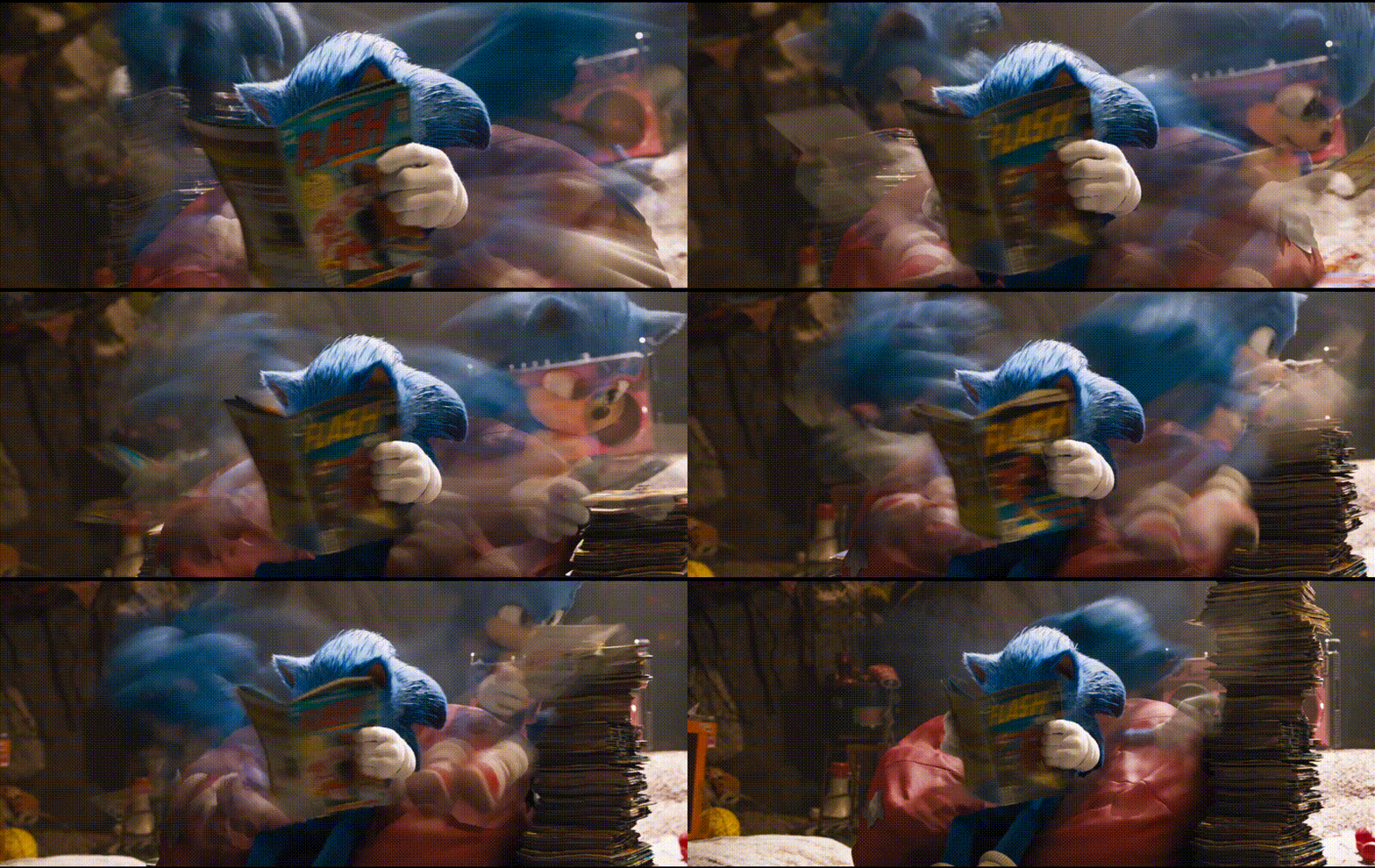
Review: 'Sonic The Hedgehog', Sonic's Big Screen Debut Can't Keep Up With A Batsh*t Jim Carrey


Sonic the Hedgehog became notorious long before its debut when promos showed how badly animators had botched his iconic look. Rather than pushing through the negative hype, the right move was made by having Blur Studios go back to the drawing board, recreating Sonic so that he resembled the furious Sega mascot gamers know and love. But that controversy is nothing compared to the new one that will arise when people see the movie, because only then will they realize Jim Carrey must've been injected with some alien hallucinogenic to be so batshit as Sonic's techno-nemesis, Dr. Robotnik.

Sonic the Hedgehog is a character borne from the 1990s, and so it makes sense that his movie be an old school kid-friendly buddy comedy. The themes are pretty easy to understand, as well, rarely straying beyond simple "friendship", as the speedy blue hedgehog with the spikey hair tries to combat his own loneliness. But whatever message the movie might have is secondary to Carrey who dominates literally every moment he's on screen. giving such an exaggerated, wacky performance it makes Fire Marshall Bill look positively tame. Carrey's pure madness personified, and it's perfect for a movie about a talking hedgehog who can run faster than the speed of sound. What in the world were you expecting Carrey to do? This ain't Eternal Sunshine of the Spotless Mind. When he wants to throw subtlety out the window he does it to the extreme, twirling his mustache and sounding like a crazy person.


While generally an upbeat movie to match the video game's tone, it actually starts pretty dark as Sonic (voiced by Ben Schwartz) flees his jungle homeworld (modeled with all the loops and swerves of the game's opening level) following a sudden tragedy. Using a bag of magic rings, he's transported to Earth and the small town of Green Hills, Montana. Sticking to the outskirts to avoid being spotted, keeps himself busy by playing baseball...by himself, playing ping-pong...by himself, and basically doing everything by himself. He's lonely, but finds comfort spying on the local townsfolk, including local cop Tom Wachowski (James Marsden) aka the Doughnut Lord, and his wife Maddie (Tika Sumpter). Unnecessary voiceover tells us that, aw shucks, Sonic isn't just super fast, he's also super lonely. Adults may not need that level of hand-holding but kids, who may think Sonic's antics look like fun, will need the push. Fortunately, Sonic isn't alone long enough for the narration to become a drag.

When Sonic's powers trigger a massive blackout, the military gets called into action in a scene so ridiculous it could've been a Hot Shot! outtake. Leading the charge, for no good apparent reason, is the overly evil private contractor Dr. Robotnik, a tech-obsessed madman whose solution to every problem is to unleash unholy drone firepower wherever he goes. And soon, that includes Green Hills, where Sonic's first encounter with Tom leads to his losing of the magic rings through a portal into San Francisco. He'll need Tom's help to get there, recover the rings, and escape through a new portal into a lonely mushroom world where it's safe.


What follows is a fairly conventional road trip story, with Marsden paired up as the affable everyman opposite a frenetic CGI animal with an attitude, much like in the film Hop. The comedy set pieces aren't terribly inspired; like a stop at a nearby motorcycle bar which ends, predictably, in a giant barroom brawl. During these sequences we do see the visual effects budget pushed with slow-motion sequences that'll be very familiar to fans of the X-Men movies. Time slows down to a crawl, leaving Sonic free to rearrange the landscape for maximum hilarity. In his feature debut, director Jeff Fowler, a veteran animator who worked on Where the Wild Things Are, shows a strong hand with the CGI action. Sonic's blue streak always looks cool when he's on the go and taking on Robotnik's vast technological arsenal. Fans of the old school platformer will dig the clever way Fowler incorporates some of the game's signature style, particularly in the climactic showdown.


Sonic could've used more of the attitude that made him Sega's antithesis to Nintendo's Mario during the video game console wars. Marsden is abnormally good at clicking with animated characters, as Tom and Sonic find common ground in their willingness to sacrifice for the greater good. Both are overshadowed by Carrey, who is so insanely over-the-top he's bound to be VERY divisive. He devours each line like a starving man on a deserted island, occasionally breaking into robot dance for no apparent reason, threating world domination like a megalomaniacal fool. I was completely into it, but your mileage may vary.

Zipping along at an appropriately brisk clip, Sonic the Hedgehog races to the finish line before you have time to fret over the details. As video game movies continue to strive for the love their comic book counterparts get, this is just a small hedgehog-sized step in the right direction. You probably won't think too hard about the movie once it's over, but don't be surprised at an urge to fire up the ol' Sega Genesis.

3 out of 5


2/12/2020

Review: 'To All The Boys: P.S. I Still Love You', Netflix's YA Sequel Is A Syrupy Sweet Treat


The soapy romantic entanglements for young Lara Jean Covey became a national phenomenon with 2018's To All the Boys I've Loved Before, a film that helped Netflix build an entire brand around YA rom-coms and the swoon-worthy Noah Centineo. You literally couldn't login without seeing his goofy face on some new movie, but he was just a small part of why that movie connected with so many. Every now and then you just need a film that is unabashedly happy, dopey, and romantic, in which you know everything is just going to work out nicely for everybody. For those who need to feel that way again, Netflix has you covered with To All the Boys: P.S. I Still Love You, and you won't be disappointed.

The absolutely radiant Lara Condor returns as the romantically-inexperienced Lara Jean, whose infamous love letters are still coming back to bite her in the butt. The sequel starts off a little odd for those who saw the prior movie, which ended with one of Lara Jean's many crushes, John Ambrose McClaren, showing up at her door with letter in hand. It was a heck of a cliffhanger given that she and high school heartthrob Peter Kavinsky (Centineo) had just become official, but that's not where the sequel picks up. Instead, a bit of retconning, and a total recasting of the John Ambrose role, finds Lara Jean receiving the letter from him the old fashioned way. It has the expected result: it blows poor Lara Jean's mind that John Ambrose would respond and...oh my gosh...does he like her back? Even after so many years apart?


In reality, love is as much about timing as anything else, and it's a lesson that Lara Jean has been getting smacked upside the head with repeatedly. Another thing she needs to learn? The reality rarely lives up to the fantasy. In the first movie, she was free to pretend to be Peter's girlfriend, and dream about what it would really be like. Boyfriend Peter? He doesn't always say the right thing, he's late to their dates, and he's popular in a way Lara Jean will always be a little jealous of. But the biggest problem with Peter? He's still very close to his ex, Gen (Emilija Baranac), and Lara Jean doesn't know how to handle that. As before, she remains stuck in the past unable to move forward.

Taking over the role of John Ambrose is Jordan Fisher, who fits with the geeky/hunky vibe these movies like for their men to radiate. A bit of contrivance finds Lara Jean and John Ambrose volunteering together at the same retirement home, where their furtive glances and jokey jabs at one another are so charming they might have you abandoning Team Peter. Fisher is a new face for me (I know he's been around, but I'm old), and he brings a different kind of energy than Centineo, that makes us believe Lara Jean could fall for John Ambrose for totally separate reasons. Their awkwardness is mutual and natural, like old friends who know how to finish one another's sentences.


You aren't going to find even a hint of edginess to this movie, though. That's both a benefit and the occasional annoyance. Lara Jean's innocence and naivete is just plain too ridiculous to believe sometimes. It was cute with the first movie, but now as her relationship with Peter has grown more complex, a bit of nuance in the adaptation of Jenny Han's novel would've helped. In particular, a brief conversation about sex, and whether Peter wants to do it, makes no sense whatsoever. Here's a tip: yes, he wants to have sex. He's a dude. Some of the choices Lara Jean makes to keep her flirtations with John Ambrose a secret are straight out of a bad sitcom handbook, and inevitably lead to a lot of embarrassing moments and broken hearts. But this is To All the Boys, and nothing stays broken for too long.

The jewel at the heart of these movies remains Lara Condor, who is as sweet and funny as ever. She dazzles in every scene and manages to find chemistry with both Centineo and Fisher. An added bonus are the wonderfully earnest family moments she shares with John Corbett as her father, who is taking those early first steps into the dating scene; Anna Cathcart as Lara Jean's matchmaking little sis, Kitty.


The trailblazing success of Crazy Rich Asians helped bring To All the Boys I've Loved Before into the spotlight, and that cultural diversity remains a strength that sets these movies apart from typical high school romantic comedies. P.S. I Still Love You is generally more of the sugary sweetness we had before, but that's okay when what we're getting is so good! Even better, we won't have to wait too long to see how Lara Jean messes things up next, because sequel Always and Forever, Lara Jean is already wrapped!

3.5 out of 5

2/06/2020

Review: 'Birds Of Prey' Goes Full Riot Squad In Wild, Hyper-Violent Atypical Superhero Movie


Is Birds of Prey even a superhero movie? I mean, there's the DC Extended Universe stinger ahead of it, featuring Superman, Batman, and Wonder Woman. But this is no ordinary superhero movie, it shares very little in common with anything we've seen and that's part of what makes it so great. A ridiculously unhinged neon splash of beat 'em up action and rainbow-colored girl power make for one of the most enjoyable comic book movies in years. Call it "fantabulous."

Margot Robbie slips back into the clown makeup and pastel-colored fashion sense of Harley Quinn, the breakout character from 2016's Suicide Squad. The ADD-riddled paramour of Joker is no longer his main squeeze (Jared Leto's version of the villain is barely glimpsed but often referenced), and going solo has only made her more erratic. This plays out in a 4th wall-breaking, quippy, time-jumping, motor-mouthed narration that is both hilarious and patience-testing. We're speed raced through her origin story using a combo of live-action and animation, ending with her basically being thrown out on the street. She handles the break-up like any normal person would, with a lot of tears, a new haircut, eating herself into a food coma, buying a pet hyena, y'know how it goes. She also gets into a LOT of trouble, because now that Joker's no longer protecting her, it's open season on Harley Quinn and she's racked up a murderer's row of enemies.


It's an ingenious point driven home by writer Christina Hodson (Bumblebee, the upcoming Batgirl movie), that Harley Quinn is so used to being under Joker's umbrella that she never once had to think about the consequences of her actions. "A Harley Quinn is meant to serve", she weeps somberly to Dinah Lance aka Black Canary (Jurnee Smollett-Bell), while indulging at the nightclub of crime boss Roman Sionis aka Black Mask (a flamboyantly Walken-esque Ewan McGregor). Who is Harley Quinn without a master?

She's batshit insane, that's what, only without any guardrails, and the direction by Cathy Yan is appropriately heightened to match her broken psyche. A thin plot emerges involving a dead mob family's priceless diamond, which gets snapped up by teen pickpocket Cassandra Cain (Ella Jay Basco), who is being protected by cop-on-the-edge Renee Montoya (Rosie Perez), who enlists Black Canary for help, only to run afoul of vengeful assassin the Huntress  (Mary Elizabeth Winstead, great at playing deadly serious). These vigilante Spice Girls must team up to stop Black Mask and his face-removing thug Victor Szasz (an unrecognizably creepy Chris Messina) from getting their hands on Cassandra.


There is no shortage of toxic men for these gals to beat up on, and Birds of Prey works best when it goes full-on riot squad. The wilder it gets, the better, like a Terminator-esque siege sequence with Harley Quinn shooting up a police station with a bean bag gun full of glitter, or a chase sequence in which she tries desperately to save the one thing in life she still cares for...a bacon, egg, and cheese sandwich. Quieter moments find Harley Quinn ruminating on her need to break free from the abusive relationships that have defined her (hence the movie's "Fantabulous Emancipation" subtitle), but it would be too much to say these times are especially deep. They're enough to give the talented Robbie a little more to do than bash skulls with a giant mallet and crack jokes. Robbie is totally in sync with this character, and in two short films has elevated her from colorful sidekick to figure of female empowerment...albeit one with a penchant for breaking legs. The contrasts within Harley, that she's a maniacal villain seeking to help an endangered child, mirror the conflicts within all of these women. Each of them must become something new, embrace a different part of themselves, if there's any hope of them working together and surviving. The theme of evolving beyond past traumas is common among male superhero characters (hello, Batman!!) and it's refreshing to see it in a major film with some of DC Comics' best heroines.

Fueled by a roaring soundtrack of stage-setting rock hits ("Barracuda" plays during one notable scene) and manic cinematography by Matthew Libatique, Birds of Prey is undeniably loud and superficially stylish, recalling the early works of Tarantino or his copycats. There's a random Marilyn Monroe music video sequence that feels ripped from a different movie, but y'know what, it works. Yan throws everything against the wall to see what splatters and sticks, and nearly all of it does. If you're going to make a movie from Harley Quinn's fractured personality, this is how you do it. Go big. And that includes the action which includes plenty of slick John Wick-style fights (the plot is pretty similar, too) elevated to Deadpool levels of comic inappropriateness. The violence is brutal, sadistic, and clashes with the overall cartoonish tone. To put a point on it, the little girl dressed as Harley Quinn in front of me had to have her eyes shielded by her mother on more than one occasion.


As a spinoff of Suicide Squad, there are stylistic similarities in attitude and atmosphere, but Birds of Prey embraces its crazy and leaves nothing left to chance. While it doesn't all come together perfectly, the gamble pays off in emancipating the film from the confines of a tired genre.

3.5 out of 5

2/04/2020

Review: 'The Lodge', Stepkids Drive Riley Keough Over The Edge In Icy Thriller From 'Goodnight Mommy' Directors


The debilitating fear and uncertainty that comes with motherhood is of particular interest to Austrian directing duo Veronika Franz and Severin Fiala, who had an art house breakout a few years ago with the domestic horror Goodnight Mommy. A few years later and they're back exploring similar themes and premise with The Lodge, another slow burn that'll have you reconsidering whether kids ought to be in your future. However, in this case it's the discord that comes with becoming a new step-parent to a pair of kids who may resort to maniacal means to keep their original family unit intact.

Once again the discordant relationship between a mother and two children is brought to freezing temperatures while stuck in claustrophobic isolation. Riley Keough gives a subtle turn as Grace, an escapee from an Evengelical cult who has found new purchase with her soon-to-be husband Richard (Richard Armitage), the reporter who covered her story. Unfortunately, his children Mia (Lia McHugh) and Aiden (Jaeden Martell) have no interest in Grace becoming part of their family. They hold her responsible for the demise of their birth mother (Alicia Silverstone), who took hard news of her ex-husband's impending marriage to the much-younger Grace.


"You left mom for a psychopath", Aiden scolds, giving us the first clue that maybe all isn't well with Grace. She keeps it well hidden, though, just like the stash of pills she takes to stay balanced. Months later, Richard takes the family to their remote lodge in the middle of a snowy nowhere, hoping all sides can come together and respect one another, if not learn to love one another. But when he's called into the city on work, leaving Grace and the surrogates alone, all sorts of weird crap starts happening, as one might expect from this genre of film.

Franz and Fiala aren't interested in crafting anything as easily-identifiable as horror, and the ambiguous nature of the story feeds into that. One morning, Grace and the kids wake up to find the power out, all of their warm clothes missing, the food has disappeared, and worse, Grace's stabilizing pills are nowhere to be found. As if it wasn't tense enough in the tiny household, perched precariously on a dangerous lake of ice, the accusations only make it worse. Are Mia and Aiden responsible for trying to push Grace over the edge, or is Grace already suffering some kind of mental break? The possibility of paranormal interference is also dangled as a possibility, with more than one clue pointing in that direction. Grace's past as a religious zealot points to something of a supernatural nature, but the same goes for the devout Mia, who seems to be headed down a similar path. You'd think they'd get along.


But for all of these red herrings, including ominous shots of a dollhouse that seems to be replicating the odd events, few prove satisfying in sustaining the mystery, as if they were thrown together at random. This is exacerbated by a disappointing reveal that will be a gut blow to horror fans hoping for something edgier, or at least one that makes sense seen in full context. The mounting household pressure is exquisitely delivered, albeit at a crawl's pace, through cinematographer Thimios Bakatakis's icy lens, giving you the sense of being trapped inside of an igloo. The performances help, as well, most of it done in cold stares and if-looks-could-kill glances. Only Keough gets anything remotely layered, as Grace's brittle psyche finds her leaning on the religious beliefs she fought so hard to escape. A surprisingly violent, forbidding finale clashes with the deliberate tone, and fails to deliver enough of a jolt for those who put their faith in The Lodge to live up to Franz and Fiala's chilling predecessor.

2.5 out of 5

2/03/2020

Review: 'Gretel & Hansel', The Brothers Grimm Tale Gets An Occult, Feminist Spin


The power that comes from a young girl's transition into womanhood has long sent chills up the spines of men, and been the basis of many a horror film by male directors. Into that specific sub-genre comes Oz Perkins' Gretel & Hansel, which as the title suggests puts an emphasis on the sister, played by It and Sharp Objects star Sophia Lillis. It doesn't take long to figure out why the Brothers Grimm tale has been flipped in such a way. Femininity, seen as both a curse and a gift, is the driving force in a film rich with symbolism and foreboding atmosphere, but not much in the way of urgency.

In this version of the story, Gretel is 16-year-old and on the cusp of becoming a woman; her brother Hansel (Sam Leakey) is an annoyingly precocious 8-year-old, always starving for food and attention. Their mother has effectively thrown them out of the house due to her own hardships, and navigating the world as a beautiful female proves dangerous for Gretel. They need work and food, but when Gretel is asked by a disgusting landowner about a job as a servant girl, his reply is to question whether she's maintained her "maidenhead" or virginity. Clearly, this guy doesn't need a servant to tidy up around the house. Hansel doesn't understand when his sister comes out jobless, all he knows is he wants cake and that dirty old man might've had some.

We aren't the only ones who perceive Hansel to be a deadweight on Gretel's back. Approaching a strangely polygonal home that smells of a buffet dinner, Hansel and Gretel are invited inside by the Witch (played by the Borg Queen herself, Alice Krige), a nefarious smile always on her face, a stern lesson about power always a moment away, and a table full of food always at the ready. She takes a keen interest in Gretel, recognizing in her a deep well of eldritch energy linked to her own origin. The Witch wants Gretel to embrace it and everything that comes with it. And to do that...well, Hansel might need to get stuffed into a meat pie or something. The boy's gotta go.


So forget the gingerbread and gumdrop houses; Gretel & Hansel is draped in shadow and rich in dark mythology, working in concert with a murky Gothic style that has become popular since Robert Eggers' The Witch. And like that film, its plodding pace and heaviness are less likely to appeal to casual audiences who are expecting more scares and a pushing beyond the PG-13 envelope. Other than a grisly smorgasbord of human entrails splayed out as the evening's supper the movie is slight on genuine chills. The film's strengths are in its evocative style blending the past and present, aided by a bold synth score by Robert Coudet, not to mention the simmering performance by Lillis, and Krige's continuing ability to scare the pants off of us with a single look. Krige is terrific here, as the Witch can barely contain her ignoble motives behind every seeming act of charity. At only 87 minutes, Gretel & Hansel doesn't dig into its womanly themes for too long, but the investment will be worth it for those eager for an occult spin on the empowerment narrative.

3 out of 5

1/31/2020

Sundance 2020 Review: 'The 40-Year-Old Version', Radha Blank's Witty Meta-Comedy Should Make Her A Star


The frustration felt by a black aspiring playwright comes fairly early on in Radha Blank's funny, observant, and overlong The 40-Year-Old Version. Radha, playing a heightened version of herself, chokes out a white producer (Reed Birney) who criticizes her play on Harlem gentrification, questioning whether a black person actually wrote it, then offering her a job writing a culturally palatable Harriet Tubman musical, instead. We don't agree with her attack, but we can kinda-sorta understand it.

The 40-Year-Old Version is shot in gorgeous 35mm black & white by Clemency cinematographer Eric Branco, giving us a gritty, street-level look at New York similar to the early work of Spike Lee. The film is never dull to look at, and that includes its star, always with a wry look in her eye and a new headwrap as she sucks down on an ever-present unknown diet drink. Radha's midlife crisis is fueled, like most midlife crises, by unfulfilled potential. A playwright whose inclusion in a prestigious "30 under 30" list set her up for greatness, Radha is instead teaching creative writing to troublesome students and struggling to pay her rent every month. In a series of montages we are introduced to her little corner of Harlem, where a 70-year-old woman offers backhanded advice, a homeless man won't mind his own business, and a Korean store owner makes lewd advances. Radha desperately wants to create, to bring the reality of her Harlem to the stage. During one funny/sad scene, she wails "I just want to be an artist!" while a saucy BBQ rib hangs on for dear life in her hand.

But it's hard out there for a black woman to find a place where her creative voice can be heard and appreciated. The system is designed to shut it out, or like in the case of that producer, to homogenize it. After his successful all-female version of 12 Angry Men, that producer wants Radha to add a prominent white character to her play, Harlem Ave, and for it to undergo extensive rewrites overseen by a white director. Radha is forced to choose between staying true to herself, or selling out to achieve what she's always wanted.

A bit aimless at first, the film eventually finds its voice just as Radha discovers hers. Tapping into her long-held passions for poetry and rap music, Radha transforms herself into rapper RadhaMUSprime (the real-life Radha's alter ego), where all of the things she hopes to say on stage can be unleashed on the microphone. With the aid of quiet, stoic producer D (excellent newcomer Oswin Benjamin), Radha experiences a creative awakening, but the pull of her white-washed play lingers, largely due to her flamboyant agent and best friend Archie (Peter Y. Kim) who won't let her give up on it.

The real-life Radha has a list of accomplishments (including writing episodes of Empire and She's Gotta Have It) that the screen version would kill (or choke someone out) for. But in her feature writing/directing debut, it's safe to say Radha has never done anything quite this personal, frequently recalling and displaying the work of her late artist mother, establishing a legacy that Radha is desperate to continue. But at what cost? Is the achievement of one's dream worth it if everything one stands for is compromised? Is that what being a true artist means? It's likely Radha is pulling from her own struggles to break into the business as inspiration for the movie's many astute and witty comments.

With so much that Radha has on her mind, there's apparently nothing left on the cutting room floor. Clocking in at 129-minutes (made to feel longer by the incorrect runtime announced by our screening's host), The 40-Year-Old Version's biggest problem is that it overstays its welcome. Radha is one Hell of a character, a very big personality, but so many of the characters in this film are over-the-top and it gets tiresome over such a long stretch. The script gets clunkier, less focused (a diversion into the world of battle rap is unnecessary) and more on-the-nose, with Radha eventually rapping her epiphany to a stunned audience's rapt approval. For a first-time feature the film is a bit rough around the edges but not without its charms, with the greatest of them being Radha herself. She's a star in the making, so look out.

3 out of 5