Showing posts with label julianne moore. Show all posts

1/27/2020

Sundance 2020 Review: 'The Glorias', Julie Taymor's Gloria Steinem Biopic Is Uneven But Engaging


Life's road is jagged, never a straight line. That's especially true for renowned feminist activist Gloria Steinem, whose life has always been colored outside of the boundaries. A biopic on her should be just as unconventional, which is why the hiring of Across the Universe and Frida director Julie Taymor for The Glorias was so exciting. And for some of the film Taymor delivers the magical realism and evocative visuals we'd hoped for, with multiple Glorias interacting with one another across multiple time periods. But just as often it slips into mediocre biopic conventions which do Steinem's story a disservice.

A sprawling effort that encompasses the vast majority of Steinem's life, The Glorias finds four different actresses portraying her through different stretches. We're introduced to her as a child (played by Ryan Kiera Armstrong), raised by her ex-journalist mom and her father, a carnival barker/salesman (Timothy Hutton) who has a scheme to get out of every financial jam. Taymor and screenwriter Sarah Ruhl's screenplay collides that Steinem's nomadic upbringing with that of her as a teenager (played by Lulu Wilson), and as a young woman (Alicia Vikander) traveling through India. It's there that she witnesses firsthand the injustices visited upon women on a global scale, helping to form the basis of the hopeful feminist hero she would later become. Following in her mother's footseps, Steinem begins making waves in the male-dominated world of journalism, facing sexual harassment and discrimination even as she outshines and outsells her colleagues.

It's during this youthful stretch where The Glorias is at its most engaging, both on a dramatic level and aesthetically. Scenes melt into one another, the many versions of Steinem interacting, giving one another advice and criticisms while journeying on a metaphysical bus to anywhere.  Sometimes these dialogs hit a little too on-the-nose, others are buried under Taymor's self-indulgence. A bizarre, unnecessary sequence finds a chauvinistic interviewer caught in the eye of a hurricane while the many Glorias are transformed into wicked Witches.

Taymor pulls in the reins as Steinem enters her forties (now played by Julianne Moore), conventionally hopping through one event to the next.  We see the formation of the Women's movement, the creation of Ms. Magazine, as well as Steinem's many friendships with activists Bella Abzug (Bette Midler), Dorothy Pittman Hughes (Janelle Monae), and Wilma Mankiller (Kimberly Guerrero). All of these women of diverse backgrounds and philosophies would shape Steinem through to her impassioned speech at the first Women's March, just as women's rights were about to be under renewed threat.

Uneven but still an absorbing ride, The Glorias remains a testament to Gloria Steinem's endurance as leader of a movement that continues to face opposition, and to the complexity of the road traveled to get where she is now.

3 out of 5

12/19/2019

'The Woman In The Window' Trailer: Amy Adams Unravels In Joe Wright's Latest Thriller


With no major projects on the big or small screen, 2019 was a quiet one for Amy Adams. However, she remains one of the most accomplished actresses around, and already 2020 is shaping up to be a big one with the mystery-thriller The Woman in the Window, from Darkest Hour director Joe Wright.

Adams leads an incredible cast that includes Oscar-winners Julianne Moore and Gary Oldman, Brian Tyree Henry, Jennifer Jason Leigh, Tracy Letts, Wyatt Russell, and Anthony Mackie. It's the most impressive lineup Wright has ever assembled, and that's saying something. The film is based on the A.J. Finn novel about an agoraphobic child psychologist who suspects foul play in the disappearance of the neighbor she had been spying on.

What's interesting about this film is that its production has been the subject of some mystery. An October 2019 release was scrubbed after a run of seriously poor test screenings, causing Disney to send it back for retooling.

It's reminding me a lot of The Girl On the Train, an awards-hopeful that turned out to be a dud, I'm curious whether we're looking at a similar situation. Wright has done some incredible films, including Atonement, Hanna, and Anna Karenina...but he's also the guy who gave us Pan.

 Even the plots share a lot in common. I guess we'll find out when The Woman in the Window opens on May 15th 2020.

SYNOPSIS: In “The Woman in the Window,” a psychological suspense thriller directed by Joe Wright, an agoraphobic child psychologist befriends a neighbor across the street from her New York City brownstone, only to see her own life turned upside down when the woman disappears and she suspects foul play. A stellar ensemble cast brings Tracy Letts’ screenplay based on the gripping, best-selling novel to life, where shocking secrets are revealed, and no one—and nothing—is what it seems. 

8/07/2019

Review: 'After The Wedding', A Surprisingly Vivid Remake That Stands On Its Own


Note: This is a reprint of my review from the 2019 Sundance Film Festival. After the Wedding opens on Aug. 9th.*

The question that plagues any remake is, "Is this really necessary?"  In most cases, the answer is no. If the original movie was great it should stand on its own and against the test of time. Who needs another one that may lack that same special ingredient? Susanne Bier's 2006 Oscar winner After the Wedding does not need an Americanized remake, and director Bart Freundlich is hardly the most inspiring filmmaker to do it, much less a gender-swapped take on such a complicated story of high emotional stakes.

And yet, the decision to swap the major roles from male to female has yielded unexpected rewards. Starring Freundlich's wife, Oscar winner Julianne Moore, Michelle Williams, and Billy Crudup, this intricate love triangle (of sorts) mirrors in nearly every way the highs and lows of Bier's, including its melodramatic tendencies. But the gender switch allows for an examination of motherhood that makes familiar twists and turns feel fresh, aided by a number of powerful performances.


A sweeping vista of India introduces us to Isabel (Williams, in the role originated by a towering Mads Mikkelsen), a simple woman who runs an orphanage in desperate need of financial aid. While she seems pretty low-key and reserved, Isabel's anger flares when the subject of money comes up, and the need to get it from wealthy donors. One of them is offering a hefty sum, but only if Isabel flies out to New York to plead her orphanage's case. The woman making that offer, and crooning loudly in her SUV to Lady Gaga, is Theresa (Moore), a multimedia mogul married to Oscar (Crudup), a famous sculptor; and caring mother to twin boys and a soon-to-be married daughter (Abby Quinn).  The differences between Isabel and Theresa couldn't be greater, and their initial meeting is hasty and somewhat confrontational. Isabel resents having to be there to basically beg for help, while Theresa seems to have a different agenda. She demands Isabel stay in New York for a few more days, then later for the arrangement to be permanent.

A series of calculated reveals make for a continually intriguing first hour, as the true nature of Theresa's actions become clear.  It isn't as simple as Isabel and Oscar sharing a history, but goes much deeper than that, which is where the decision to change the lead characters from male to female really shines, allowing for an interesting examination of motherhood in all of its various forms. But it's hardly the only deep secret that comes to the surface, with each changing the power dynamic in ways both subtle and profound. Isabel, always on edge in an unfamiliar setting, constantly questions Theresa's motivations for offering the money then seeming to withhold it. Theresa is indeed dangling something of far greater significance than cash, while keeping other secrets that have her on an emotional roller coaster. One minute she looks to be the willing philanthropist, the next she's drunkenly attacking everyone in sight.


Freundlich still isn't the most inspiring filmmaker but he knows to give his actors ample room to perform. Williams continues to be somewhat aloof, but it works for her in this case as Isabel has reason to be on her guard. As internalized as Williams' performance is, Moore's is twice as expressive and at times volcanic, with Crudup shining as the conflicted Oscar.  And proving once again that her breakout turn in Landline was no fluke, Quinn is terrific in depicting a confused young woman whose life has unexpectedly been thrown into upheaval. Bier's film descends into sobbing melodrama but not quite to the level of Freundlich's remake, which does eventually lose control of the careful intricacies it had spent so much time crafting. After a while, there's just one twist too many and it gets a little ridiculous.

The biggest shock to me is how this take on After the Wedding does stand on its own. You can love Bier's film and love this one, as well, for very different reasons and it seems to me that's how a remake should work.

Rating: 3.5 out of 5

6/06/2019

'After The Wedding' Trailer: Julianne Moore Has A Devastating Secret For Michelle Williams


Summer isn't the time when we'd expect a bunch of Sundance favorites to arrive but it seems like we're getting three or four of them a day all of the sudden. The latest is the American remake of Susanne Bier's Oscar-nominated After the Wedding, which takes the complex drama and gives it a gender-flipping twist. And you know what? It's actually for the better.

This version of After the Wedding stars Julianne Moore, Michelle Williams, and Billy Crudup, with Williams in the role previously-played to tremendous acclaim by Mads Mikkelsen. Williams stars as Isabel, a social worker from Kalkata who flies to New York to meet Theresa (Moore), the wealthy benefactor willing to fund her cause if she stays in town for her daughter's wedding. But Theresa has a hidden motive that involves her husband (Crudup), and a dangerous secret from the past.


By changing the focus to female, writer/director Bart Freundlich gives an already complicated story of intersecting relationships a timely, feminist spin, with maternal instinct right at the heart of it. I went in thinking this would be a waste of my time, but came out thinking this is one case where the remake is on par with the original

Check it out for yourself when After the Wedding opens on August 9th.

4/09/2019

Julianne Moore, JJ Abrams, And Stephen King Team For 'Lisey's Story' Apple Series


So why did Apple do that underwhelming event for their subscriber service Apple TV+ when they could've waited a couple of weeks and had a show like this to tout? Deadline reports Stephen King and JJ Abrams are teaming on a new series, Lisey's Story, and it will star Oscar-winning actress Julianne Moore. Damn.

Lisey's Story is based on the King novel that he's been wanting to see adapted for years. It tells two stories centered on the titular wife of a renowned novelist. In the present, we follow Lisey as she copes with her husband's death and remembers things about him she had long suppressed. The other story is of her husband's life as remembered by Lisey.

King thought up the novel's premise while recovering from the 1999 incident in which he was struck by a van. It's a deeply personal story for him which is why he's taking a more hands-on approach than usual, writing all six episodes. Abrams is on board as a producer.


3/13/2019

Review: 'Gloria Bell', Julianne Moore Dances The Night Away In Sebastian Lelio's Spirited Remake


When you need someone to lend credibility to an American remake of an acclaimed foreign drama, you could do worse than Julianne Moore. Sebastian Lelio's redo of his 2013 hit Gloria, now-titled Gloria Bell, is Moore's second such film behind the Sundance-debuting After the Wedding. Just as her presence there helped center and elevate the material in fresh ways, so too does she give a spirited performance here that makes this version of the familiar story stand on its own.


Practically a shot-for-shot remake, Lelio's film has only one thing going for it to justify its existence, and that, of course, is Julianne Moore. She plays the title character, a middle-aged divorcee who lives alone (except for one sneaky cat) but isn't content with being lonely. She gets along well with her ex-husband (Brad Garrett), and endures that her adult-aged children don't have any need for her anymore. Rather than sitting around the apartment fretting over things she can't control, Gloria prefers to dance the night away at disco clubs where she has no trouble meeting men. It's clear she's looking for something, and one night she finds it in Arnold (John Turturro), a recently-divorced man who is funny and awkward but still confident enough to take the dancefloor.


Gloria is about a woman on the road to happiness, but what is particularly enjoyable about the first half of it is that she already seems well on her way. An adventurous soul, she's always looking for something new to experience, and Moore has us wanting to go on this journey with her. Even as we, and Gloria, learn more about Arnold and his inability to refuse his lazy, dependent children and needy ex-wife, it's all like a minor speed bump that Gloria will overcome on her way to the life she wants.


Maybe Turturro is a little too good at playing Arnold. Turturro is capable of adding layers to loud, mawkish characters and adding depth to pitiful sadsacks, which Arnold definitely falls in the latter category. But Arnold is such a lost cause that Gloria gets dragged down with him, and soon we begin to question why such a lively and beautiful woman keeps giving him a chance, only to get burned in increasingly humiliating ways.


The beauty of Gloria is the woman at the center of it and her infectious lust for life. While the film tackles issues familiar to the midlife coming-of-age genre, such as independence and starting over, it's the way Gloria heads into the future with her eyes wide open, ready to take on the challenges that await. Gloria is in every way on par with its predecessor, which to some may make it redundant, but one can never complain about too much Julianne Moore in a role she's perfect for.

Rating: 3.5 out of 5

1/25/2019

Sundance Review: 'After The Wedding', A Surprisingly Vivid Remake That Stands On Its Own


The question that plagues any remake is, "Is this really necessary?"  In most cases the answer is no. If the original movie was great it should stand on its own and against the test of time. Who needs another one that may lack that same special ingredient? Susanne Bier's 2006 Oscar winner After the Wedding does not need an Americanized remake, and director Bart Freundlich is hardly the most inspiring filmmaker to do it, much less a gender-swapped take on such a complicated story of high emotional stakes.

And yet, the decision to swap the major roles from male to female has yielded unexpected rewards. Starring Freundlich's wife, Oscar winner Julianne Moore, Michelle Williams, and Billy Crudup, this intricate love triangle (of sorts) mirrors in nearly every way the highs and lows of Bier's, including its melodramatic tendencies. But the gender switch allows for an examination of motherhood that makes familiar twists and turns feel fresh, aided by a number of powerful performances.


A sweeping vista of India introduces us to Isabel (Williams, in the role originated by a towering Mads Mikkelsen), a simple woman who runs an orphanage in desperate need of financial aid. While she seems pretty low-key and reserved, Isabel's anger flares when the subject of money comes up, and the need to get it from wealthy donors. One of them is offering a hefty sum, but only if Isabel flies out to New York to plead her orphanage's case. The woman making that offer, and crooning loudly in her SUV to Lady Gaga, is Theresa (Moore), a multimedia mogul married to Oscar (Crudup), a famous sculptor; and caring mother to twin boys and a soon-to-be married daughter (Abby Quinn).  The differences between Isabel and Theresa couldn't be greater, and their initial meeting is hasty and somewhat confrontational. Isabel resents having to be there to basically beg for help, while Theresa seems to have a different agenda. She demands Isabel stay in New York for a few more days, then later for the arrangement to be permanent.

A series of calculated reveals make for a continually intriguing first hour, as the true nature of Theresa's actions become clear.  It isn't as simple as Isabel and Oscar sharing a history, but goes much deeper than that, which is where the decision to change the lead characters from male to female really shines, allowing for an interesting examination of motherhood in all of its various forms. But it's hardly the only deep secret that comes to the surface, with each changing the power dynamic in ways both subtle and profound. Isabel, always on edge in an unfamiliar setting, constantly questions Theresa's motivations for offering the money then seeming to withhold it. Theresa is indeed dangling something of far greater significance than cash, while keeping other secrets that have her on an emotional roller coaster. One minute she looks to be the willing philanthropist, the next she's drunkenly attacking everyone in sight.


Freundlich still isn't the most inspiring filmmaker but he knows to give his actors ample room to perform. Williams continues to be somewhat aloof, but it works for her in this case as Isabel has reason to be on her guard. As internalized as Williams' performance is, Moore's is twice as expressive and at times volcanic, with Crudup shining as the conflicted Oscar.  And proving once again that her breakout turn in Landline was no fluke, Quinn is terrific in depicting a confused young woman whose life has unexpectedly been thrown into upheaval. Bier's film descends into sobbing melodrama but not quite to the level of Freundlich's remake, which does eventually lose control of the careful intricacies it had spent so much time crafting. After a while, there's just one twist too many and it gets a little ridiculous.

The biggest shock to me is how this take on After the Wedding does stand on its own. You can love Bier's film and love this one, as well, for very different reasons and it seems to me that's how a remake should work.

Rating: 3.5 out of 5

11/13/2018

'Gloria Bell' Trailer: Julianne Moore Is Living Her Best Life In Sebastian Lelio's Remake


You know how this story goes: acclaimed foreign film opens in the United States, gets great reviews but is overlooked by most audiences. So a few years later we get an English-language remake with bigger stars attached. The difference in the case of Gloria Bell, a remake of Sebastian Lelio's 2013 film Gloria, is that the original director is back behind the camera, and he'll be working with Oscar-winner Julianne Moore in the title role.

The first trailer for Gloria Bell has Moore in the most spirited role she's had in years. The film centers on a divorcee who is seeing her youth slip away, so she decides to spend her free time dancing the night away on the club scene. There she learns to love again, and come to grips with her past in an effort to move forward in her life.

Paulina Garcia won the Silver Bear at the Berlin Film Festival for her performance in the original film, and it looks like Moore could be due for some honors herself.  Moore received a ton of praise after the TIFF premiere a couple of months ago, and I suspect that will continue. Lelio has also become a critical favorite lately, having directed both Disobedience and A Fantastic Woman recently.

Also starring Michael Cera, John Turturro, Jeanne Tripplehorn, Brad Garrett, and Sean Astin, Gloria Bell opens March 8th 2019.

9/13/2018

Review: 'Bel Canto', Julianne Moore And Ken Watanabe Try To Find Passion During A Hostage Crisis


Bel Canto has all of the makings of a great film; a harrowing true story, a talented assemblage of stars, and a director in Paul Weitz who has stumbled upon occasional dramatic success since leaving his American Pie roots behind. Based on the Ann Pratchett novel which drew inspiration from the 1996 Japanese Embassy hostage crisis, Bel Canto sets out to be a passionate look at the romantic and cultural bonds that can form during captivity, but the one thing the movie is lacking above all else is passion. What's left is a film so dull it could be used as torture by one's captors.

There's simply no energy or narrative momentum to be found, leaving too much of the dramatic burden placed on the shoulders of stars Julianne Moore and Ken Watanabe. In virtually any other scenario they would be more than capable, and they do their best here, but they lack the necessary chemistry to pull it off. He plays Japanese businessman Katsumi, who travels to Peru to attend a lavish party thrown by the country's vice-president because in attendance will be Roxane (Moore), his favorite opera singer. It's safe to say Katsumi is a little bit obsessed; while a calm, serious man in most respects he is very clearly flustered when in her presence, and the language barrier doesn't help. Within moments of her performance, members of a revolutionary outfit storm the mansion demanding to see the president so they can force him to release their imprisoned compatriots. But the president never arrived, and the terrorists' leader Commandant Benjamin (Tenoch Huerta) is forced to go to plan B and take hostages.


Weitz and co-writer Anthony Weintraub drop the ball with the film's most intriguing aspect. After the shock has worn down from the initial attack's violence, the captors and captives begin to settle into a strange domesticity, spurred on by one young soldier's accidental killing of a hostage. While Benjamin finds negotiating with the government difficult, on the inside he and the others begin to look at the hostages as more than just bargaining chips, but as people. They start forming what looks like a commune of social elites and working class soldiers, exactly the kind of union Benjamin and his people claim to be fighting for. This weird little paradise finds Katsumi getting  exactly what he desired most, a personal audience with Roxane, who begins to let her diva guard down. Katsumi's loyal translator Gen (Ryo Kase) falls for Carmen (Maria Mercedes Coroy), a poor revolutionary desirous of learning the English language. Weitz is a little too effective at showing the daily monotony of their capture, and the myriad romantic entanglements are only a brief respite. The stakes never feel quite as high as they should for a house full of armed terrorists, and a government on the outside eager to charge in guns blazing. The only thing stopping a potential bloodbath is the work of a frustrated crisis negotiator (Sebastian Koch) who gets some of the film's most intense scenes. He alone seems to know where things are headed, and watching him evolve from confident to befuddled to panicked shows an avenue I wish Bel Canto had traveled further.

As normalcy and capitulation set in, too many of the hostages never break out of their stupor. Watanabe is charismatic as ever, looming over every scene like a well-respected patriarch, but he finds little in common with Moore, and they lack the romantic spark needed to enliven their scenes together. Moore has the most to work with, as Roxane is shown to be the only hostage willing to defy her captors, knowing of the value she has to them. The one thing Moore can't do? Lip sync. While famed soprano Renee Fleming provides Roxane's powerful singing voice, Moore's clumsy miming would have LL Cool J booting her off Lip Sync Battle.


Weitz has a worthy story to tell about love under the most trying of circumstances, but stripped of any urgency and danger, Bel Canto fails to give the crisis the big screen treatment it deserves.

Rating: 2.5 out of 5

8/07/2018

'Bel Canto' Trailer: Julianne Moore's Voice Gets Ken Watanabe Through A Deadly Crisis


Bel Canto admittedly sounds and looks pretty corny, but when the stars are Julianne Moore and Ken Watanabe it really doesn't matter. The hostage drama is based on the acclaimed novel by Ann Pratchett, which drew inspiration from the Japanese embassy hostage crisis in 1996. The Oscar-winning actress plays world famous opera singer Roxanne Coss, whose voice melts the heart of a wealthy industrialist played by Watanabe.

What you have is the potential for a beautiful, well-acted love story, but what unfolds is something else entirely. The soiree in which Moore and Watanabe's characters meet is attacked by guerrila fighters who take them and others hostage, in hopes the government will free their imprisoned comrades. Despite the terror they all face, the hostages find strength in one another and form unexpected relationships, with Roxane's voice binding them together.

Paul Weitz, best known for About a Boy and Mozart in the Jungle, directed and co-wrote the script with Anthony Weintraub. Sebastian Koch, Christopher Lambert, Ryo Kase, Tenoch Huerta, and María Mercedes Coroy co-star.

Corny or not, it's a story that has won millions of fans across the globe, even being adapted into an opera in 2015. That's why I find the release schedule a bit perplexing. Bel Canto will hit theater on September 14th, then move to VOD a week later.

7/12/2018

Mark Rylance Is 'Waiting For The Barbarians', Julianne Moore Joins 'The Woman In The Window', And More


Oscar-winning Bridge of Spies and Ready Player One star Mark Rylance is confirmed to lead adaptation Waiting for the Barbarians. J.M. Coetzee's allegorical 1980 novel centers on a magistrate and loyal servant to "the Empire", who begins to reconsider his role in the regime after witnessing the brutal treatment of prisoners of war. The film will be directed by Ciro Guerra, best known for Best Foreign Language Film nominee Embrace of the Serpent. [THR]


Julianne Moore may be joining Amy Adams in the Rear Window-esque thriller, The Woman in the Window. Based on the book by AJ Finn, the story centers on an alcoholic recluse in New York City who spends too much time spying on her nearby neighbors. When a new family moves in she witnesses something she shouldn't have that changes her life. Moore will play the mother of a mysterious young boy who moves in across the street, presumably from the family Adams' character is infatuated with. The talent on board for this is incredible, with Joe Wright (Atonement) directing from a script by acclaimed playwright/actor Tracy Letts. The Woman in the Window opens October 4th 2019. [THR]


Blockers breakout Geraldine Viswanathan is joining Hugh Jackman and Allison Janney in high school dramedy Bad Education. Thoroughbreds director Cory Finley is at the helm with a script by I Think We’re Alone Now writer Mike Makowsky. Comparisons to the classic school satire Election are already going around, although actual plot details are being kept under wraps. What we do know is that it will be based on Makowsky's own high school experiences.

2/08/2018

Julianne Moore To Lead 'After The Wedding' Remake; Willem Dafoe Enters 'The Lighthouse' And 'Motherless Brooklyn'


Julianne Moore is set to star in a remake of Susanne Bier's Oscar-nominated Danish film, After the Wedding. The original film starred Mads Mikkelsen as an orphanage manager in India who travels to Denmark at the behest of a wealthy benefactor who happens to be married to the manager's greatest love. This updated version will be written and directed by Moore's husband, Bart Freundlich, and will be reimagined with two women as the leads. [Variety]


Fresh off his Best Supporting Actor Academy Award nomination for The Florida Project, Willem Dafoe is in talks to star in The Lighthouse, a thriller from The Witch director Robert Eggers. Details are slim, but we know it will be set at the start of the 20th century and follow Maine lighthouse keepers. [Deadline]

Meanwhile, Dafoe is also part of Edward Norton's growing ensemble for Motherless Brooklyn. Norton will write and direct the picture that will feature Bruce Willis, Gugu Mbatha-Raw, Alec Baldwin, Leslie Mann, Michael K. Williams, Ethan Suplee, Cherry Jones, Robert Wisdom, Fisher Stevens, and Josh Pais. Set in 1950s New York, the story follows Lionel Essrog (Norton), a lonely private detective afflicted with Tourette’s Syndrome, as he ventures to solve the murder of his mentor and only friend, Frank Minna (Willis). Armed only with a few clues and the powerful engine of his obsessive mind, Lionel unravels closely-guarded secrets that hold the fate of the whole city in the balance. [Deadline]

11/02/2017

Julianne Moore To Play Feminist Icon Gloria Steinem In 'My Life On The Road'


Right now you can find Julianne Moore in two movies: George Clooney's Suburbicon and Todd Haynes' Wonderstruck. Neither of which is likely to put her back on the Academy Awards stage again (How about a nom for Kingsman: The Golden Circle?), but her next film might, especially with Hollywood looking for more stories on real-life female heroes.

Moore is set to play Gloria Steinem in My Life On the Road, based on her memoir adapted by playwright Sara Ruhl. Behind the camera will be Julie Taymor in her first film since 2010's The Temptest. The film will chronicle Steinem's evolution from activist to feminist icon, still very much active today.

Expect a lot of eyes to be on this one. Maybe they'll hold the first screening at the White House? Eh, probably not. [Deadline]

10/27/2017

Review: Todd Haynes' 'Wonderstruck', An Admirable But Flawed Cinematic Journey


Both Martin Scorsese and Todd Haynes have found themselves lured into the world of author Brian Selznick's novels, although neither would seem to be a perfect fit on paper. Scorsese earned one of his least-expected Oscar nominations for the 3D fantasy adventure, Hugo, showing a surprising connection with the imaginative clockwork world. There is a similar tale of magical happenstance and unexpected friendship that unfolds in Haynes' adaptation of Wonderstruck, and while cinematically rich with breath-taking production design for two distinct time periods, the title turns out to be misleading.


When I think of Todd Haynes I don't necessarily think "family friendly" or "kiddie" anything, and he seems far more interested in bringing to life the roaring '20s and '70s in a way that mirrors the periods' cinematic styles. The earlier piece is set in gorgeous black & white, done completely without dialogue like a silent movie. The latter, set fifty years later, features an array of over-saturated browns and oranges, jazzed up by Carter Burwell's popping score. It's Burwell who proves the master storyteller here, even moreso than Haynes, giving each era its own distinct feel while necessarily moving the plot forward. See, the two protagonists, Ben (Oakes Fegley), and Rose (Millicent Simmonds), are deaf, putting an extra burden on Burwell's score to communicate feelings and the passage of time.


While set decades apart, it's inevitable that Ben and Rose's stories will intersect at some crucial juncture. Ben is a small-town kid from Minnesota, whose mother (Michelle Williams) has promised to tell him the identity of his father, but she died in a tragic accident and now he lives with an aunt. That is until a twist of fate takes away his hearing, and in a fit runs off to New York City to investigate clue to his father's whereabouts. Fifty years earlier we get the story of Rose, a deaf girl from Hoboken, New Jersey who runs away to Manhattan to find her idol, an actress played by Julianne Moore.


The film leaps between both stories haphazardly, attempting to draw parallels between Rose and Ben's experiences. Haynes struggles to find a narrative to connect us with either child, and it doesn't help that their deafness leads to dull, drawn-out scenes with characters writing on notepads, or having simple misunderstandings. Everything feels just out of step for too long, and there's a distinct lack of mystery and awe for a film that teases an otherwordly connection. Things settle just as Haynes finally begins to discover that childlike spirit we've been hoping for. Haynes finds it in a museum, where so many of us created unforgettable memories as children. Both Ben and Rose have some of their greatest adventures within a museum's halls, and in artifact-filled "cabinets of wonder", large rooms where any number of curiosities could be found.


As Haynes begins to find his groove, so do his young stars. Simmonds, a deaf actress in her feature debut, is the breakout here in a more demanding role. Her unique face and natural expressiveness are easy to watch and lend authencity to the 1920s segments, in which she works alongside multiple deaf actors. Fegley, who was most notably seen in Disney's Pete's Dragon remake before this, is solid his affliction is too often used as a plot contrivance. Moore, who takes on two small but pivotal roles, continues to cement herself as Haynes' muse. The Far from Heaven and Safe star is, as always, the glue that holds Haynes' films together.


Wonderstruck is an immaculately designed ode to classic cinema, and those with an appreciation for such things will find much to admire. Just don't expect to be struck by wonder.

Rating: 3 out of 5

10/24/2017

Review: 'Suburbicon', Part Crime Comedy, Part Race Drama, Mostly Disappointing


Note: when the Coens don't direct their own scripts, expect that there's a good reason for it. Just based on the title and the filmmakers' sensibilities you probably have a good idea of what Suburbicon is: the Coens' dark take on suburban comedy. And that would be true, and maybe if it were them behind the camera the film might have turned out in a more coherent fashion than it does with their pal George Clooney at the helm. Clooney has struggled with black comedy before and continues to here; his traditional style of direction simply isn't built for it, but what is most disappointing is that Suburbicon could have been two really good separate movies.


Suburbicon stars Matt Damon as Gardner Lodge, a classic 1950s Dad living in an idyllic, lily-white neighborhood where you might expect to see an apple pie cooling in every window. The town is turned upside down by the arrival of a black family into their pristine neighborhood, causing a rapid fire town meeting where its decided to basically make their lives Hell. A massive fence will be erected to shield those precious white eyes from those dirty blacks, and that's nothing compared to the 24-hour rioting going on right outside their door. In the midst of all this, Gardner and his wheelchair-bound wife Rose (Julianne Moore), their young son Nicky (Noah Jupe), and Rose's twin Margaret are held captive by a couple of violent goons with an axe to grind. Is it because Nicky was seen playing with his black neighbor? In any case, it all ends with Rose's death, and soon thereafter Margaret moves in because, y'know, "the boy needs a mother." 


Riiiiiiiight.

Of course it's fishy. This is the Coen Brothers and everybody has a corrupt angle to play. If that were all there was to it, Suburbicon would have been fine.


The screenplay is credited to the Coens, Clooney, and his writing partner Grant Heslov. Okay, fine. But Clooney and Heslov's contribution is basically to shoehorn in this sobering racial drama on top of the Coens' crime caper, based on a completely different story they were writing independently. The two approaches hardly ever gel, and to say the racism aspect is underserved would be a massive understatement.  The family, known as the Meyers', aren't really characters here. Sure, Nicky goes out and plays catch with the son every now and then when Clooney wants to make a nod towards racial harmony, but that's all they are. Representations.


Sadly, the film is much better when it focuses on the Lodges and the quicksand of lies and murder Gardner finds himself sinking into. Gardner's predicament will feel familiar to anyone who has a passing knowledge of the Coens' canon. The body count stacks up in increasingly ridiculous and gruesome ways. And it should come as no surprise the film excels when it allows for comical subversions of the era. Gardner, seemingly the model of stoicism and masculinity, is a nervous wreck humiliated with broken glasses and the occasional ride on a child's Schwinn bicycle. Oscar Isaac has the best 5 minutes of the movie as a slimy insurance investigator, back when families actually knew the name of their insurance agents, who thinks there's something fishy about the Lodges' recent claim. And there's something precious about Margaret, who relishes a little too much getting to play mother and wife, while dreaming vacantly about trips to the protectorate of Aruba. Aruba comes up a lot. Margaret's role isn't given enough space to really grow, but we've seen Moore play up the 1950s housewife so many times already we can fill in those spaces on our own.


Somewhere lost in the middle of Suburbicon is a really funny crime story, and a potentially powerful one about racism. Put together they make for a watchable, if mediocre entry for both the Coens and Clooney.

Rating: 2.5 out of 5


9/20/2017

New Trailer For Todd Haynes' 'Wonderstruck' Explores A Mystery In Two Eras


If there's a drawback to debuting at Cannes it's that latter films take away some of the spotlight. That seems to be the case with Todd Haynes' Wonderstruck, which has been drowned out at Telluride and TIFF over the last few weeks. But the adaptation of Hugo author Brian Selznick's fantasy novel has some major appearances left, including the New York Film Festival, and if all goes well it will be back in the awards discussion soon.

Taking place in two separate eras, the film follows two children on separate life-changing adventures. Julianne Moore, Oakes Fegley, Michelle Williams, Jaden Michael and Millicent Simmonds star. Here is the official synopsis, which speaks to the ambitious narrative under Haynes' command:

Based on Brian Selznick’s critically acclaimed novel Ben and Rose are children from two different eras who secretly wish their lives were different. Ben longs for the father he has never known, while Rose dreams of a mysterious actress whose life she chronicles in a scrapbook. When Ben discovers a puzzling clue in his home and Rose reads an enticing headline in the newspaper, both children set out on quests to find what they are missing that unfold with mesmerizing symmetry.

Wonderstruck opens October 20th.

9/19/2017

Review: 'Kingsman: The Golden Circle' Is Brash And Stylish As Before, Minus The Staying Power


Kingsman: The Secret Service was a thrill in the way every adaptation of a Mark Millar comic is. From Kick-Ass's takedown of the comics industry, to Wanted's subversion of the action movie, the film was a sucker punch to the tired old spy movies of James Bond and John Le Carre. Directed by Millar's pal Matthew Vaughn it boasted a visual flair and cheeky British stylishness that was undeniably fun. But does that feeling last all the way through its sequel, Vaughn's first ever sequel, Kingsman: The Golden Circle? Well...yes and no.


I've often said that any Millar story is fleeting, in that they make a broadsided point about the target genre and then there's nothing left to say. Well, Kingsman: The Golden Circle doesn't have anything to say, except for maybe a half-hearted point about ending the war on drugs, but it also doesn't need one. The garish attitude, sophomoric humor, and mind-blowingly daffy action sequences are all there. You will have a blast, that's for sure. But at 2 1/2 bloated hours that feeling is tough to hold on to.


There's no wasting time as things pick up with Kingsman agent Eggsy (Taron Egerton) jumped by a former member and taken on a high-speed Terminator 2-esque chase to the tune of Prince's "Let's Go Crazy". It's a singularly Kingsman style action sequence; there's so much logic-defying stuff going on at every corner of the screen that the senses overload, until the whole thing ends in an explosion of some kind. Eggsy's no longer the rookie we were introduced to before. Now he's their top agent, leading a double life in which he's shacked up with Tilde (Hanna Alström), the...*ahem* backdoor princess he saved at the end of the last movie. That they brought her back at all and in a more dignified manner I assume is to quiet those who found her first appearance particularly grotesque. Don't worry, there will be fresh offenses for the other few women who appear.


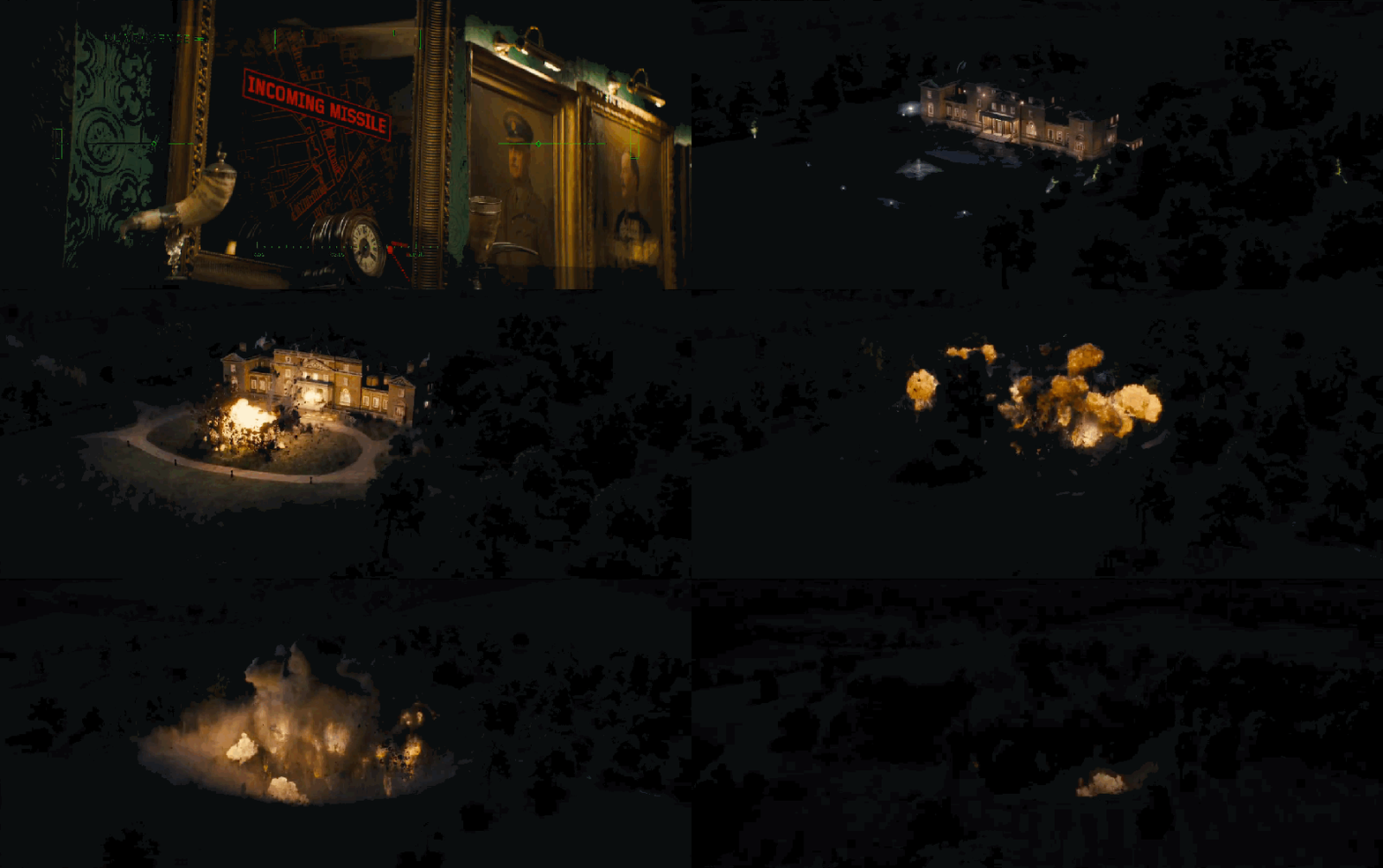
Eggsy's still close to all of his pals from home, as well as Kingsman's resident weaponeer Merlin (Mark Strong) and best friend Roxy (Sophie Cookson), but just as things are getting too normal everything is quite literally blown to bits. A series of missiles targeting every Kingsman stronghold around the world will do that. Off Eggsy and Merlin go to America, where they uncover their stateside counterparts, the Statesman, run out of a whiskey joint...with a headquarters that looks like an actual whiskey bottle, and complete with a team of rowdy southern agents. Jeff Bridges is their gazillionaire leader, with Channing Tatum as shotgun packin' cowboy Agent Tequila, Pedro Pascal as whip-wieldin' badass Agent Whiskey, and Halle Berry as their tech genius, Ginger Ale. Oh, and another surprise: they're holding on to Eggsy's former mentor, the assumed deceased Harry Hart (Colin Firth), in one of the more ludicrous "returns from the dead" scenarios ever put on screen. Then again, making ludicrous look cool is what these movies do.

Unlike its predecessor, 'The Golden Circle' isn't set out to parody other espionage movies. Its aims are less focused even as Vaughn and co-writer Jane Goldman broaden their ambitions with a bigger budget and more starry cast. If there's satire to be found it's in the villainous character of Poppy, played by Julianne Moore in what I can only think is an homage to her '50s housewife characters in Far from Heaven and The Prize Winner of Defiance, Ohio. Poppy is a world class drug dealer, but cheerful as all get-out as she leads her criminal organization The Golden Circle from a hidden jungle HQ called "Poppy Land". She's fashioned it with jukebox diners and candy-striped barbershops, the whole 1950s deal.  Of course, there are also weaponized attack dogs and legions of armed goons who will do literally anything she asks. Poppy puts on quite the meaty display of her power pretty early on, showing that her wholesome disposition hides a psychotic streak. Her malevolence goes global when she infects hundreds of millions of drug users with a deadly disease, holding the cure hostage until the U.S. President (Bruce Greenwood) makes all narcotics legal.


The plan got a round of applause at the screening I attended, apparently with a bunch of potheads. Actually, it shows the murky moral ground the film walks on because a lot of people may not see Poppy and her extreme methods as "evil". But then, there are people out here who would probably welcome The Purge as a real thing, too.


For what it's worth a greater emphasis is placed on Eggsy's relationships with others, and the costs they pay for his being a member of Kingsman. The key one, of course, is with Harry who has suffered a form of amnesia that has him studying butterflies rather than kicking evildoer butt. Without Harry saving him, Eggsy would still be just some low class street punk, and a large part of the film is whether Harry will become his old self again. There's also the question of how far Eggsy should put his faith in Harry to return from his injuries, especially when the world is at stake and all. Also, Eggsy repeatedly finds himself in hot water with Tilde due to his ridiculous mission parameters. One, that I'm sure is going to have some women up in arms, has him implanting a tracking device in a hot suspect he encounters at the Glastonbury Music Festival. Note I said "implanting a tracking device IN" and not "on", with the subsequent first-person perspective sure to get snickers from adolescent boys everywhere.


Kingsman is as brash and cocksure as ever, and it's hard not to get wrapped up in its swagger. The cast have adopted that attitude for their roles, too, which only makes these films more fun to watch. Firth and Eggsy get considerably more to do this time around, at least on a character level. They're not just beating up lowlifes in bars (that happens again) or fighting bad guys with all sorts of odd gadgets (that happens in spades), but their characters have actual arcs to roll through. Pedro Pascal is dead-on perfect as Whiskey, who has a better whip game than Indiana Jones or anybody in Fifty Shades of Grey. While Tatum, Berry, and Bridges don't get nearly enough time, at least Tatum gets to dance so that's a plus. Moore is a little too spot-on as Poppy, and Strong is basically the franchise's Mr. Reliable. He should be leading his own spy movies, but he's developed a great rapport with Egerton as Eggsy's right-hand man.  There's another role that really defies any kind of explanation and that is by Elton John, playing himself as a grumpy Poppy Land captive. There's too many laughs in it to give anything away, but I've never been a fan of the feather boa'd rocker before and suddenly I'm humming the tune to "Saturday Night's Alright (For Fighting)." Chances are you will, too.


As Vaughn's film moves from one international set piece to the next, you begin to feel that epic runtime weighing it down. Cockiness and cool factor can only go so far. Hopefully when the inevitable third Kingsman film happens, it'll pack the same energy and bravado in a package the size of a shot of whiskey.

Rating: 3 out of 5